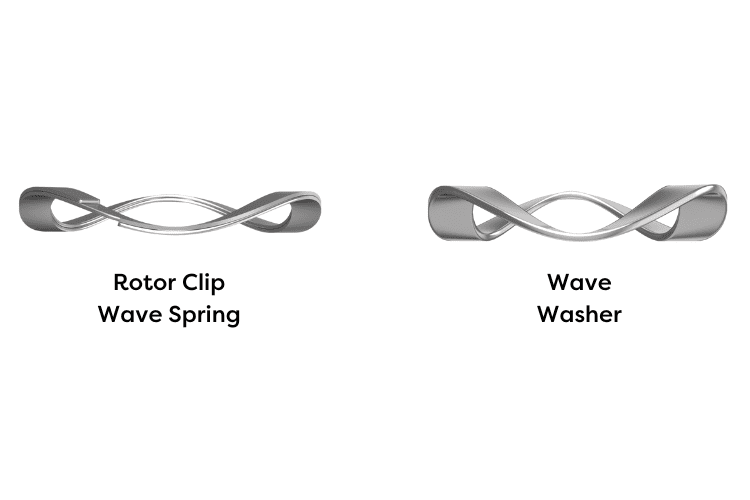
Plain Ends
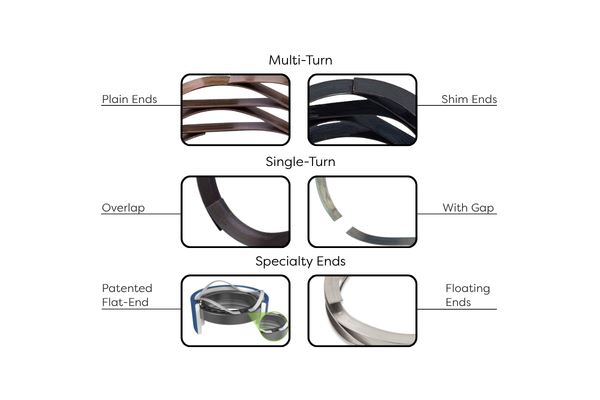
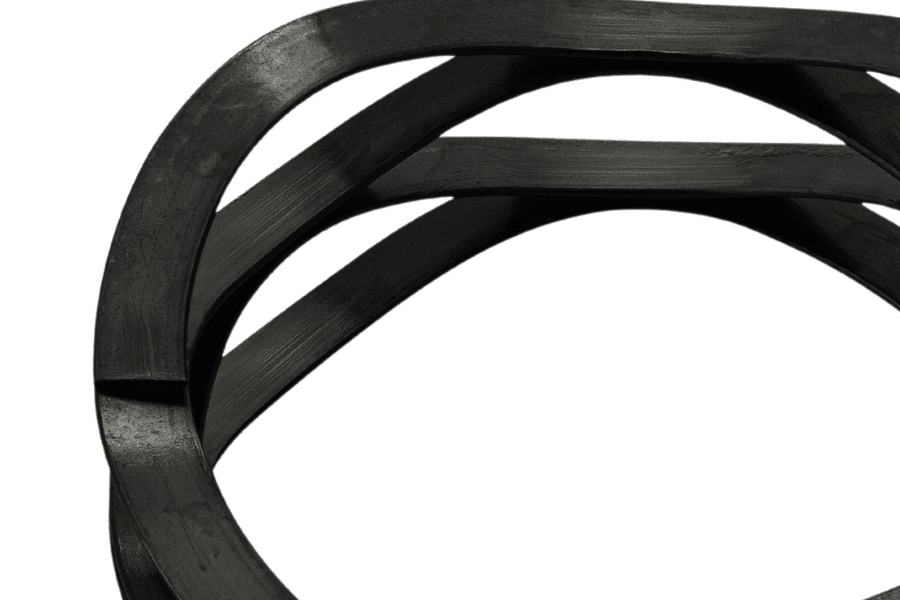
Plain ends are the standard configuration for multi-turn wave springs. The spring terminates at the next wave peak, providing consistent contact with mating surfaces and uniform load distribution across the spring.
Multi-Turn Wave Springs Engineered for Space-Constrained Applications
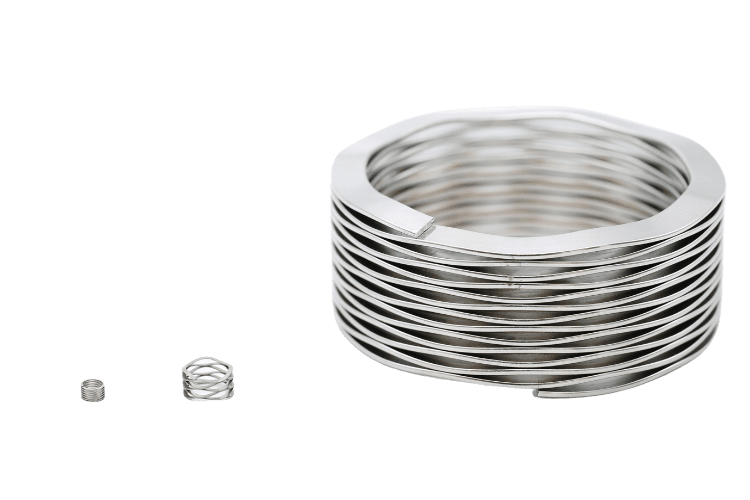
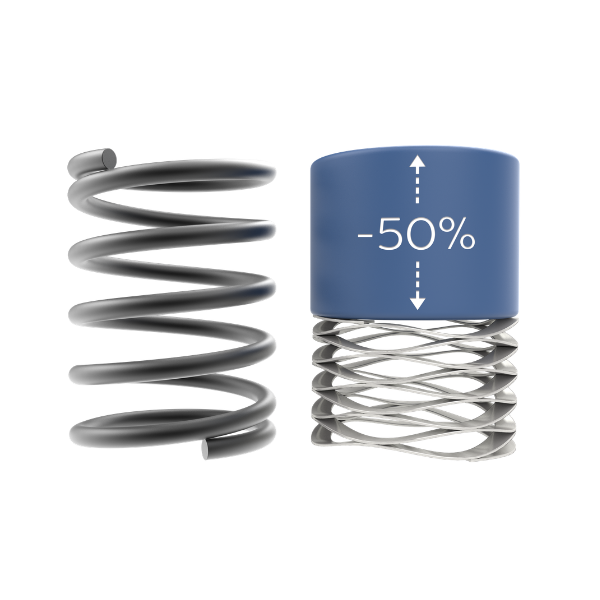
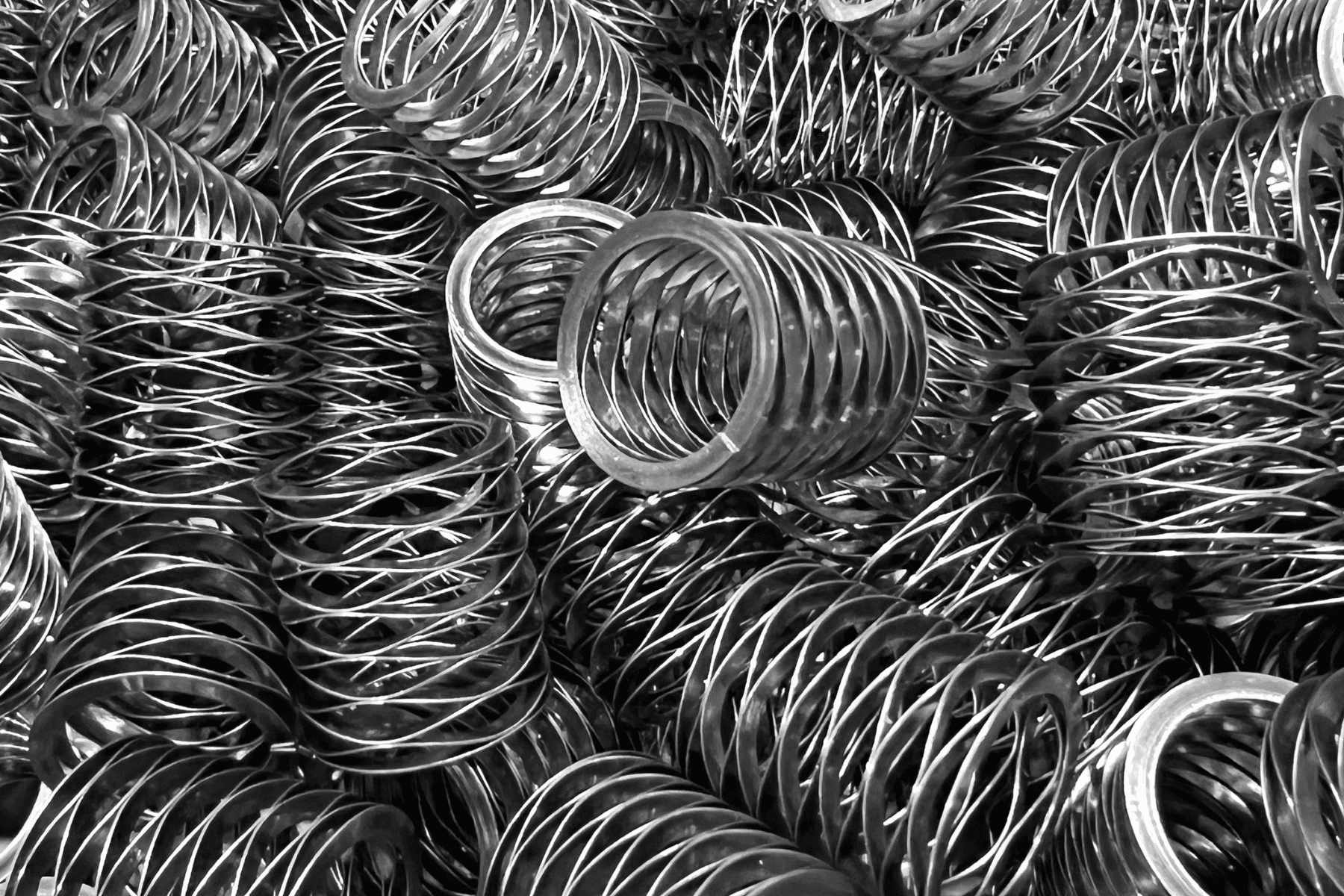
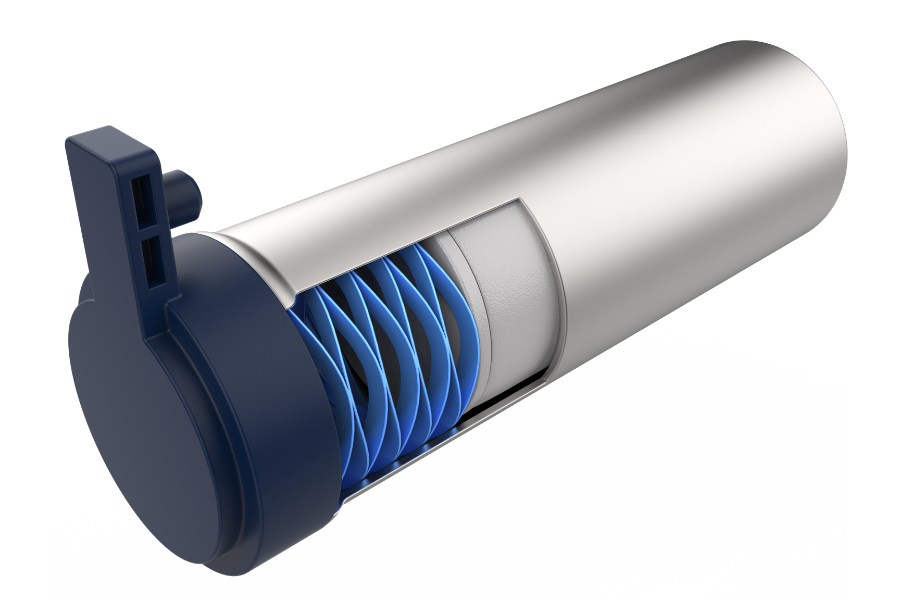
Multi-Turn Wave Springs provide force and deflection equivalent to those of conventional coil springs while requiring significantly less axial space. Unlike round wire coil springs, they are manufactured from flat wire coiled into multiple turns, each with a wave-like profile. While conventional coil springs store and release energy through torsion, Multi-Turn Wave Springs generate force through bending, with load distributed across the wave structure rather than through the torsional loading of the spring wire.

Compare how Rotor Clip Multi-Turn Wave Springs perform relative to traditional coil spring designs across key engineering characteristics.
| Feature | Rotor Clip Multi-Turn Wave Spring | Traditional Coil Spring |
|---|---|---|
| Axial Space | Up to 50% less | Greater space required for equivalent load |
| Force Method | Pure bending | Mostly torsion |
| Load Distribution | Distributed across multiple waves | Concentrated along helical wire |
| Component Replacement | Replaces multiple spring components in certain applications | Multiple springs required in stack configurations |
| Assembly | Single-component installation | Handling and alignment of multiple components |
| Design Flexibility | Wide range of forces, deflections, and geometries | Limited to standard spring geometries |
| Materials | Broad alloy selection | Typically carbon or stainless steel |


Traditional Belleville washers or disc springs can present challenges in applications requiring precise, repeatable loads and accurate positioning. Rotor Clip Multi-Turn Wave Springs provide an alternative that can help simplify assembly and support consistent performance.
Wave spring end types influence how the spring is seated against mating components, directly impacting load distribution, surface contact, and overall application performance. Selecting the appropriate end type helps minimize surface wear and allows the spring to function as intended within the assembly.
Rotor Clip offers different end-type configurations for Multi-Turn Wave Springs to support different surface conditions, material types, and assembly requirements.
Plain ends are the standard configuration for multi-turn wave springs. The spring terminates at the next wave peak, providing consistent contact with mating surfaces and uniform load distribution across the spring.

Shim ends include additional flat turns at the top and bottom of the spring. These flat sections help distribute load more evenly across the surface, making them suitable for uneven mating surfaces such as grooves, holes, or slots, as well as softer materials like plastics, rubbers, or soft metals.
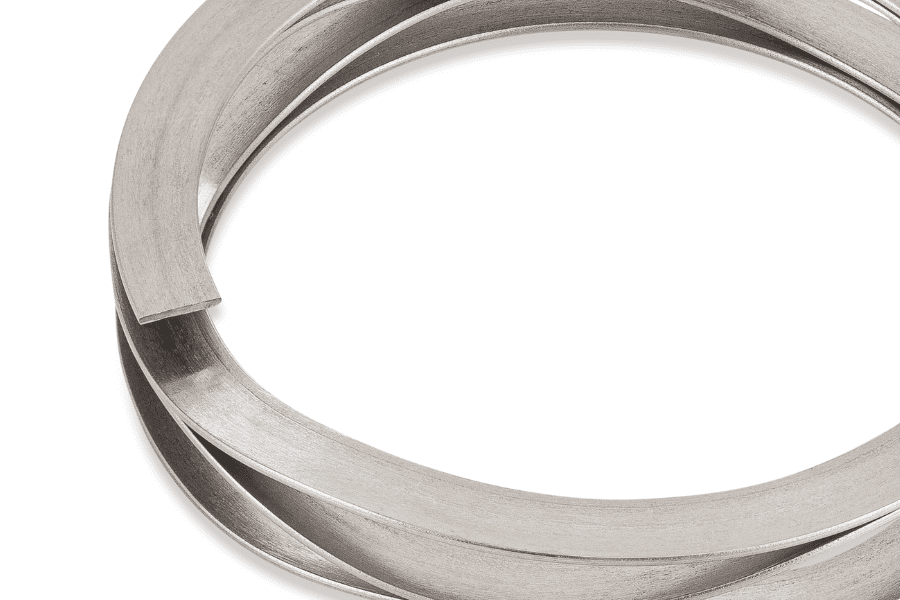
Floating ends are cut slightly shorter so the spring end does not rest directly on the adjacent wave peak. This design reduces concentrated contact points and helps minimize the potential for scratching or surface damage, particularly in applications with thicker wire or sensitive mating surfaces.
Watch our latest Multi-Turn Wave Spring video for an overview of wave springs, including how they are manufactured, different configurations, and key design considerations. The video highlights how these springs are used to meet space, load, and assembly requirements in different applications.
Explore All Wave Spring Solutions
Multi-Turn Wave Springs are used in applications where axial space is limited and consistent load is required. Common applications include:


At Rotor Clip, our engineering team supports customers from initial design through full production. Whether it involves wave spring selection, material selection, or application-specific assembly considerations, we work directly with your team to help identify the right ring or spring solution for your application.

The InterShim™ Wave Spring is engineered for reliable performance in demanding applications. Featuring alternating inactive (flat) and active (waved) turns, this patented design withstands torsional loads and high acceleration, ensuring precise and reliable performance when rotational movement is present.
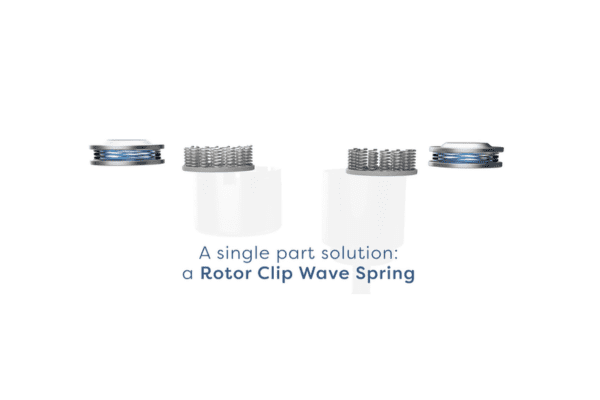
Rotor Clip Wave Springs can simplify assemblies by replacing multiple components, such as pocketed coil springs or stacked Belleville washers, in applications where component reduction and assembly simplification are required. Wave springs deliver the same force and deflection as coil springs, but with the added benefits of space and weight savings.
Watch our latest video to see how a single wave spring can be used to optimize this transmission assembly!

Rotor Clip Nested wave springs are a type of Multi-turn wave spring where the layers are coiled in parallel to form a continuous coil of layers, significantly enhancing load performance for high static load applications in limited space. By multiplying loads and spring rates as the number of turns increases, they provide a compact, single-part solution for demanding applications.
Explore our most frequently asked questions on multi-turn wave springs.
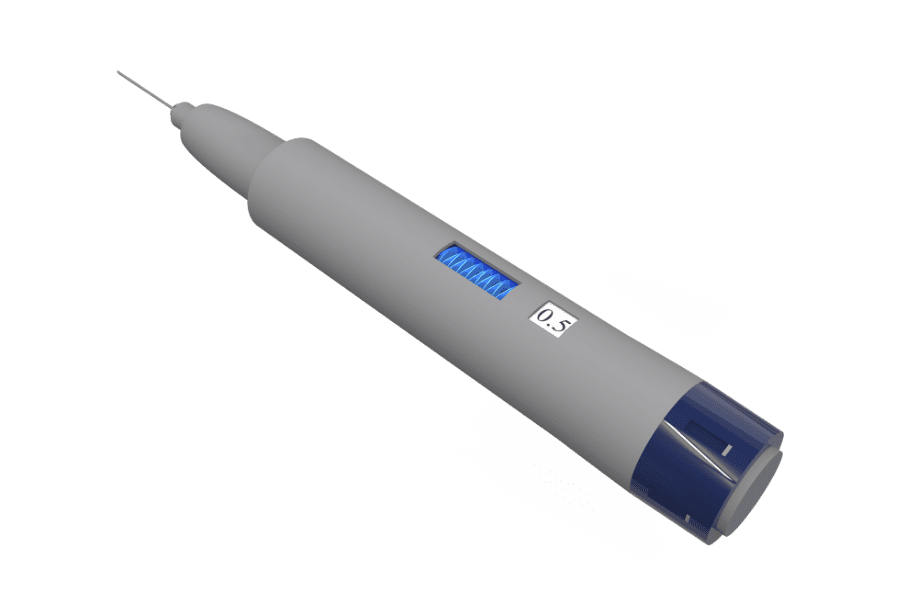
Multi-Turn Wave Springs are used in applications requiring low to medium spring force with relatively large deflection, particularly where axial space is limited. Common applications include bearing preloads, valve assemblies, clutch mechanisms, medical devices, and aerospace systems.
A Multi-Turn Wave Spring can reduce axial space by up to 50% compared to a traditional coil spring producing the same force. This can contribute to smaller assemblies, reduced overall component stack height, and weight savings.
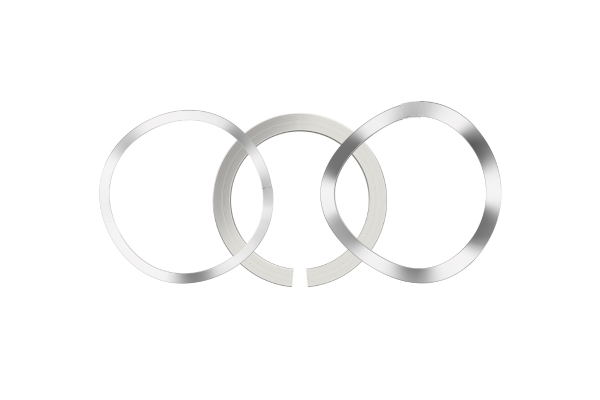
A Single-Turn Wave Spring consists of a single wave layer and is typically used for short deflection, low-to-medium force applications in compact spaces, such as bearing preload and tolerance take-up. A Multi-Turn Wave Spring uses multiple turns to achieve greater travel while maintaining a compact axial profile.
A Multi-Turn Wave Spring can often replace a conventional helical compression spring, and in some designs, an entire stack of coil springs. This can reduce axial space requirements and simplify assembly by reducing component count.
Rotor Clip offers Multi-Turn Wave Springs in carbon steel, stainless steel (including 302, 316, and 17-7 PH), Inconel, Elgiloy, Hastelloy, and other specialty alloys. Material selection depends on load requirements, temperature, operating environment, and application constraints. Contact our engineers for guidance on the most suitable material and finish for your application.
Yes. Rotor Clip specializes in custom wave spring designs and can modify parameters such as diameter, wire thickness, number of turns, waves per turn, end type, material, and finish. Many custom configurations can be produced without special tooling, helping support efficient manufacturing and lead times. Multi-Turn Wave Springs are highly customizable and are often specified in custom configurations as frequently as standard options. Because wave springs are produced through a coiling process rather than stamping, special tooling is typically not required.
We’re here to help engineers understand how wave springs can optimize your assembly over traditional methods. Explore some of our technical resources now.
Our passion is creating the best rings, springs, and clamps. Our mission is to make your work a success. We are here for you.