


Why Engineers Are Replacing Belleville Washers with Wave Springs
If you’re working with a compact assembly that requires preload, positioning, or load control, chances are you’ve used or considered Belleville washers or disc springs. These components are well established in applications where axial force is needed in a limited space. However, their performance is tied to stacked configurations or fixed stamped geometries, which can introduce variability in alignment, assembly, and load consistency.
This variability is a key reason engineers are increasingly selecting wave springs as an alternative. Wave springs use a continuous wave geometry to generate controlled spring force in a single component, removing the need for stacked assemblies and reducing variation associated with multi-part configurations. Compared to Belleville washers and disc springs, this results in more consistent force behavior and simplified assembly. Let’s delve into some of the wave spring options that can replace these types of springs below.
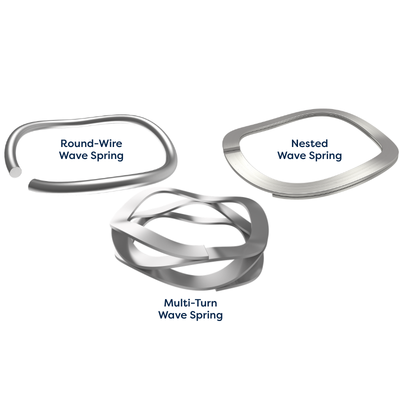
Round-Wire Wave Springs
Round-wire wave springs are typically used in higher load applications where a single disc spring would not provide sufficient force or stability. Because these springs are formed from coiled wire rather than stamped material, load is generated through continuous geometry rather than discrete stamped features.

Key design considerations include:
- Greater loading capacity
- More accurate load control
- Reduced radial footprint
- Less material waste — coiled not stamped
These are commonly used in static or low-cycle applications where load consistency is more important than deflection range.
Multi-Turn Wave Springs
Multi-turn wave springs are used where a single Belleville washer or disc spring would typically be selected, but a more controlled load profile or simplified assembly is preferred. Their wave geometry distributes load through multiple contact points during compression, producing a stable force response without stacked components.

Key design considerations include:
- Up to 50% axial space savings
- Single-component assembly
- Custom waves, thickness & end-type
- Wide load & deflection range
This configuration is used where consistent load behavior is required in a compact axial space.
Nested Wave Springs
Nested wave springs are used when a single disc spring or wave spring cannot achieve the required load within the available axial space. Multiple wave layers are arranged in parallel to increase load capacity while maintaining alignment as a single assembly.

Key design considerations include:
- No manual stacking required
- Multiplied load per added layer
- Reduced misalignment risk
- More reliable, consistent force
This configuration is typically used in higher load, space-constrained assemblies.
Wave Spring Material Options
Rotor Clip wave springs provide a broad range of material options compared to Belleville washers and disc springs, allowing selection based on corrosion resistance, high temperature performance, conductivity, strength, and other environmental requirements, adding another factor in their selection as a replacement.
Custom Wave Spring Solutions
Where traditional springs and Belleville washers are limited in design flexibility, wave springs are engineered to meet application-specific force, deflection, and load requirements without relying on stacked components or fixed stamped geometries.
Rotor Clip supports this through in-house design, prototyping, and production, providing control over spring geometry and material selection throughout development.

Design modifications include:
- Outside or inside diameters from .118″ – 24″ (3 mm – 610 mm)
- Material thickness
- Radial wall (material cross-section)
- Number of waves
- Number of turns
- Alloy selection
- End configurations
Why Wave Springs Are an Ideal Choice
Watch our video for an in-depth look at wave springs, including how they are designed, how they function, and where they are used across applications.
Need assistance in selecting the right wave spring for your application?
Rotor Clip engineers will support you from prototype through production, helping align design parameters with application requirements and performance targets.
More than Parts. A True Partnership.
Our passion is creating the best rings, springs, and clamps. Our mission is to make your work a success. We are here for you.