


Eliminates Machined Grooves
These rings eliminate the need to machine a conventional retaining-ring groove, removing a machining step and lowering part cost.

Self-locking and push-on retaining rings provide compact, cost-effective axial retention without the need for a machined groove. Depending on the design, the ring grips the shaft or bore using prongs, friction, or formed indentations.
These groove-free retaining rings are best suited to low-thrust applications where space, installation efficiency, and production cost matter most. Rotor Clip offers internal and external configurations in standard sizes from .058″ to 1.000″ for inch styles and 1.5 mm to 50 mm for metric styles, depending on the ring design, with materials and finishes available for a range of assembly and operating requirements.
Available in multiple configurations, Rotor Clip’s self-locking and push-on rings are engineered to maximize pressure distribution and gripping strength. Offered in a range of sizes, materials, and finishes, and manufactured entirely in-house to meet global quality standards, these rings provide consistent performance and reliability across a wide range of standard applications.
See some of the key features and benefits of Rotor Clip self-locking and push-on retaining rings below.
These rings eliminate the need to machine a conventional retaining-ring groove, removing a machining step and lowering part cost.

Most designs install by pushing the ring into position by hand, with a simple tool, or with automated equipment, which suits high-volume assembly.

Specialized prongs, notches, or self-formed indentations grip the shaft or bore to hold components in place against low axial loads.

Once seated, most self-locking and push-on rings are difficult to remove, making them a good fit for assemblies that won’t need to be taken apart.
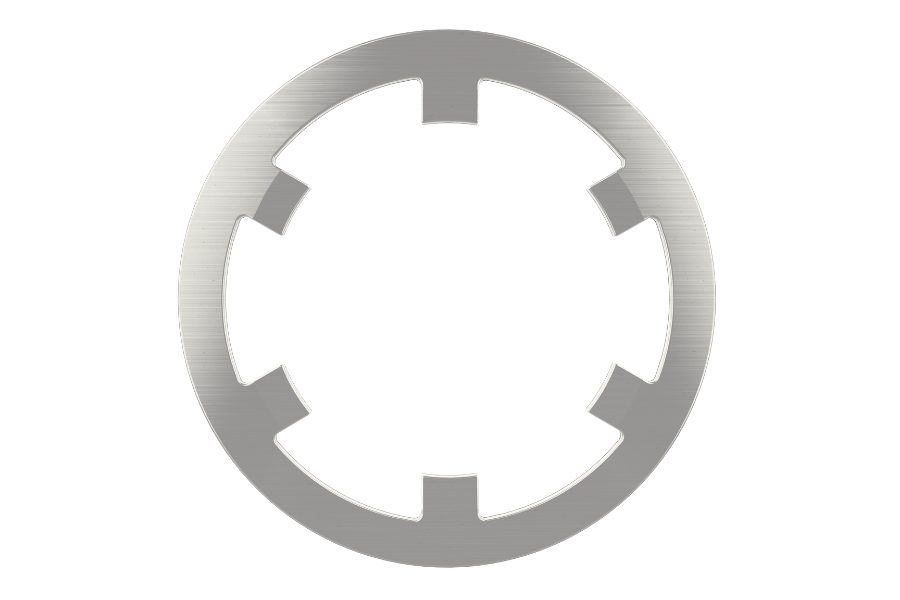
Push-on rings use a series of flexible prongs that create interference with the shaft or housing/bore to hold the ring in place. External rings feature prongs that point inward to grip the shaft, while internal styles use outward-facing prongs that grip the bore. Styles: TX, TY, TI, DTX, DTI
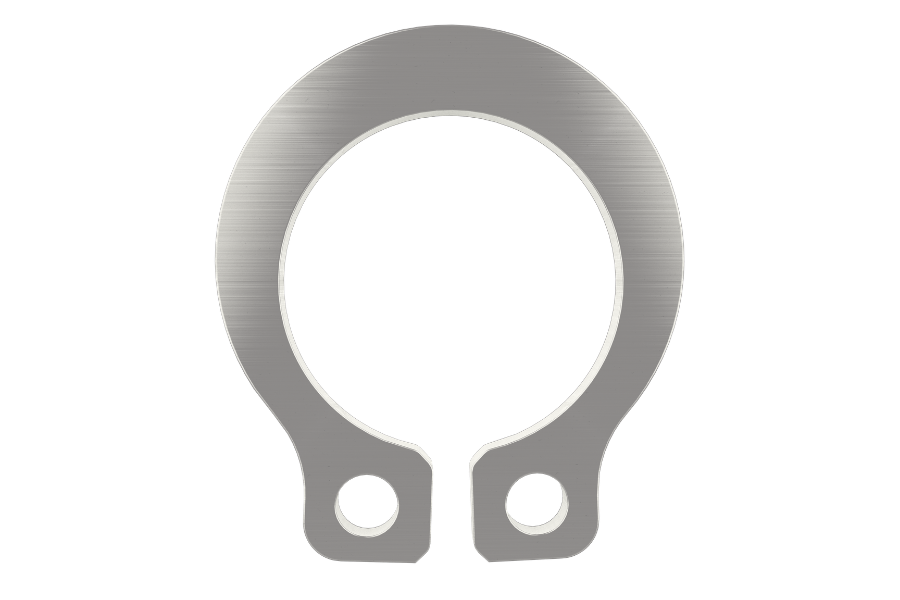
Friction rings use the ring geometry and spring tension to exert significant gripping power uniformly on the shaft, instead of using prongs to create interference. These external rings provide axial retention without the need for machined grooves. Styles: SHF
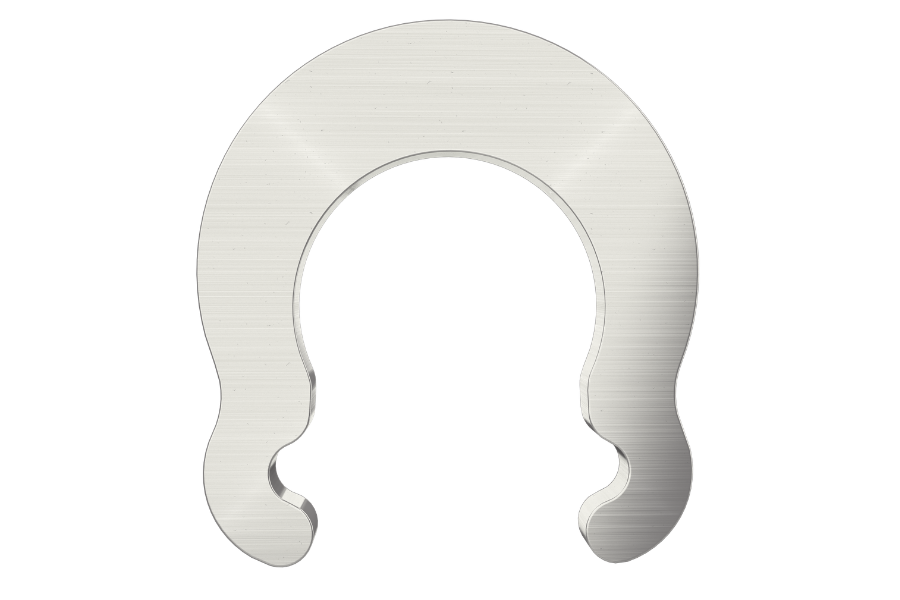
Radial grip rings install from the side instead of being pushed along the shaft. On softer shaft materials the ring forms its own groove, increasing holding power. The ring can be installed directly against the face of the retained part to help minimize end play. Style: RG

Self-locking and push-on rings are designed for simple installation by pushing or pressing the ring onto the shaft or into the bore until fully seated. Once installed, the ring grips securely to help maintain axial retention throughout the assembly.
These rings are designed to remain securely in place and are not easily removed. Removing the ring usually deforms its gripping edges, so we may recommend installing a new ring rather than reusing one.
Note: Installation and removal methods may vary depending on ring style and application requirements. For assistance, contact our engineers for application-specific guidance.
Rotor Clip self-locking and push-on retaining rings are available in a range of materials, including carbon spring steel, stainless steel, and beryllium copper. Finishes include phosphate, zinc plating, and others, depending on the ring style, size, material and application.

These groove-free retaining rings are used in automotive, consumer, electronics, appliance, and industrial applications. They are especially where a groove would be impractical or costly.
See common examples of how these rings are used across different applications below.


The terms are often used interchangeably, but they aren’t quite the same. Self-locking rings grip a shaft or bore without a machined groove. Push-on rings are self-locking designs that are pressed axially into position. All push-on rings are self-locking, but not every self-locking ring is a push-on design.
No. Self-locking and push-on retaining rings are designed to provide retention without a machined retaining-ring groove. The RG radial grip ring works differently, it installs radially and makes its own groove on a soft shaft, so no machining is needed.
These rings are well suited for low-thrust applications where compact design, groove-free retention, and efficient assembly are important. Examples include automotive assemblies, electronics, appliances, and consumer products.
Installation depends on the retaining ring design. External push-on styles such as TX and TY can be installed using a cylindrical plunger, with the ring pushed or tapped onto the shaft. Internal push-on styles such as TI and DTI install into the housing or bore. Rotor Clip offers grip-ring retaining ring pliers designed for SHF and DSF external friction rings, while RG rings are installed radially onto a soft shaft.
Yes, but they are designed to remain securely in place once installed and are not easily removed. Removal may deform the ring, so replacement is recommended when necessary to maintain proper retention. For assistance with ring removal or reuse, talk to a rotor clip engineer. They can review your application and provide guidance based on your specific requirements.
Material and finish availability varies by ring style and size. Common options include carbon steel, stainless steel, and beryllium copper, with phosphate finishes and zinc plating options available depending on the ring style and application.
Our engineers can help determine the right material and finish based on your requirements.
Our passion is creating the best rings, springs, and clamps. Our mission is to make your work a success. We are here for you.


