

Number of Turns and Waves Per Turn
The wave springs within a triple interlaced design must have the same number of turns and waves per turn to function together as a single assembly.
Explore Available Wave Spring Styles Request Wave Spring Samples
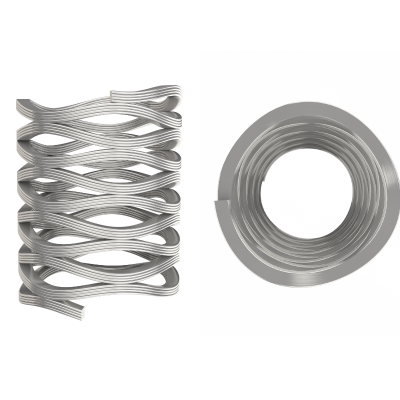
When an application requires more force than a standard multi-turn wave spring can provide within the available space, an interlaced wave spring design can offer a solution. This case study highlights how Rotor Clip engineers developed a custom triple interlaced wave spring for a valve application requiring wear compensation, a high minimum force requirement, and specific axial travel within the available space.
A customer approached Rotor Clip about designing a wave spring for a valve application requiring a high minimum force while compensating for wear over the life of the assembly. Traditional multi-turn wave springs were evaluated for the application, but the required force and axial travel would have caused the springs to become overstressed. The stresses generated during compression would have exceeded the material’s yield strength, resulting in permanent plastic deformation. To meet the application requirements, Rotor Clip engineers developed a triple interlaced wave spring design. The solution provided the required force and axial travel while maintaining acceptable stress levels, meeting the application requirements without increasing the available axial space.

A triple interlaced wave spring consists of three individual wave springs with the same number of turns and waves per turn, interwoven to function as one cohesive unit. During compression, the three wave springs work together to provide increased force output while meeting the required axial travel for the application. Unlike a standard multi-turn wave spring, which is manufactured from a single strip of flat wire formed into multiple turns, a triple interlaced wave spring combines multiple wave springs into a single assembly. This design approach allows for increased force output when a standard multi-turn wave spring cannot meet the required force and travel needs within the available application space.
A triple interlaced wave spring is based on the same spring principle as multiple springs acting in parallel, where the force generated by each spring is added together while the deflection remains the same. For example, if one wave spring is designed to provide a nominal load of F, three matched wave springs interlaced together can provide an approximate load of 3F at the same deflection. While adding interlaced turns to a regular multi-turn wave spring can increase force, it also increases the spring’s work height, requiring additional axial space within the assembly. By increasing the effective material thickness through multiple turns acting in parallel, a triple interlaced design achieves higher force while maintaining a compact axial height.
Triple interlaced wave springs and standard multi-turn wave springs are both used to provide axial force and deflection within an application. However, their designs differ in how force is generated and how each configuration addresses application requirements.
| Characteristic | Standard Multi-Turn Wave Spring | Triple Interlaced Wave Spring |
|---|---|---|
 |
 |
|
| Design | Single strip of flat wire formed into multiple turns | Three wave springs with the same number of turns and waves per turn, interwoven to function as one cohesive unit |
| Force Capability | Determined by the spring design, material, and application requirements | Approximately three times the load of a single spring of the same design when three matched springs are interlaced |
| Method to Increase Force | Adjust spring geometry, material, or other design parameters | Interlace multiple wave springs into a single assembly |
| Force & Stress Considerations | Higher force requirements can increase stress levels within a single multi-turn wave spring design. | Multiple wave springs work together to achieve higher force requirements. |
When designing a triple interlaced wave spring, several of the same factors used for multi-turn wave springs must be considered, including load requirements, deflection, material selection, and available space.
The wave springs within a triple interlaced design must have the same number of turns and waves per turn to function together as a single assembly.

The required deflection range should be evaluated to ensure the spring provides the required load while remaining within the material’s operating limits.

Material selection influences the available force, operating temperature capability, corrosion resistance, fatigue life, and overall performance of the wave spring design.

Bore or shaft diameter, free height, and work height should be considered early in the design process to ensure the wave spring fits within the available application space.
For this valve application, the triple interlaced wave spring design allowed Rotor Clip engineers to meet the required force and axial travel without overstressing a traditional multi-turn wave spring. It demonstrates how a custom wave spring design can address load, deflection, space, and operating requirements when a standard design is not suitable. Rotor Clip engineers also customize single-turn, multi-turn, nested, and round-wire wave springs for specific applications.
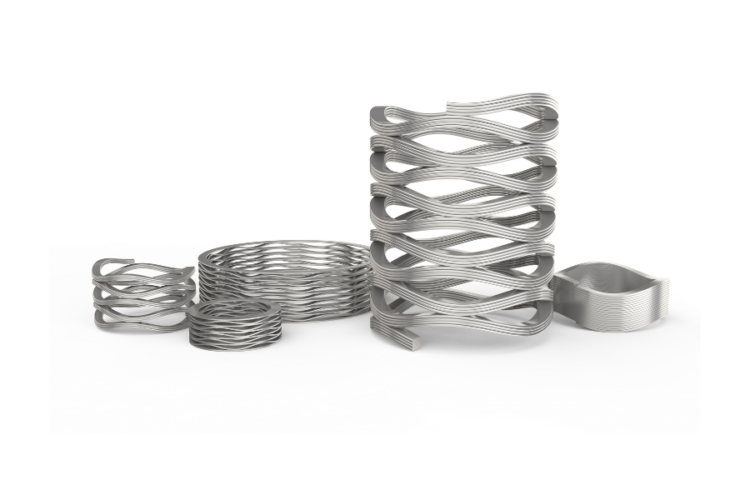
Wave springs can be customized based on factors including:
|
Design Parameters
|
Design Variables
|
Review common questions about custom wave spring designs, interlaced wave springs, and the factors considered when selecting a wave spring solution.
An interlaced wave spring is created by interweaving multiple wave springs into a single assembly. Because each spring contributes to the total load, interlaced wave springs can provide higher force within a limited axial space than a single wave spring of the same design.
A custom wave spring should be considered when a standard configuration cannot meet the required load, deflection, space, or operating requirements of an application. Custom designs can be developed around specific application needs, including dimensions, materials, and operating conditions. Rotor Clip engineers work directly with customers to evaluate application requirements and develop custom wave spring designs optimized for the application.
A multi-turn wave spring is manufactured from a single strip of flat wire formed into multiple turns. An interlaced wave spring uses multiple wave springs manually interwoven into one assembly to achieve higher force output within the same available space.
In many cases, no. Wave springs are manufactured through a coiling process and can often be customized without dedicated tooling.. For interlaced designs, the individual wave springs are then manually interwoven into a single assembly to achieve the required performance.
Adding additional turns to a standard multi-turn wave spring may increase the spring’s work height, requiring additional axial space within the assembly. A triple interlaced wave spring distributes the load across multiple interwoven wave springs, allowing higher force to be achieved while maintaining the available installation space.
Based on the principle of springs arranged in parallel, three matched wave springs interlaced together can provide approximately three times the force of one individual spring at the same deflection.
Our passion is creating the best rings, springs, and clamps. Our mission is to make your work a success. We are here for you.