Top 10 Tips

|
TOP 10 TIPS For Wave Springs
Flat-wire wave springs, an increasingly accepted alternative spring technology, come in single- and multi-turn versions that install easily in a variety of preloading and power transmission applications. Read on for some useful wave spring tips. TIP 1 – 5 |
||
 |
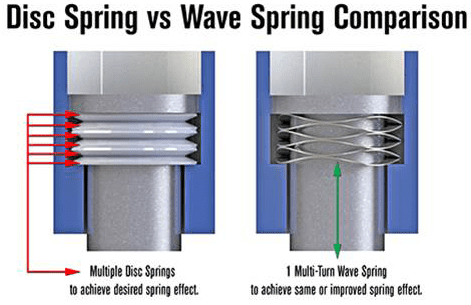
Wave springs can replace stamped washers, coil springs, and disc springs. Single-turn wave springs replace stamped washers in applications such as bearing preloads, seals, and vibration damping. Multi-turn wave springs take the place of coil springs and disc-spring stacks in seals, power transmission, and fluid power applications.
|
|
 |
Wave springs are more compact than coil springs. In static applications, uncompressed multi-turn wave springs can be half as tall as coil springs capable of delivering the same spring force. For dynamic applications, the height difference is closer to 30%. This makes wave-springs’ designs more compact with attendant weight and material cost savings. |
 |
 |
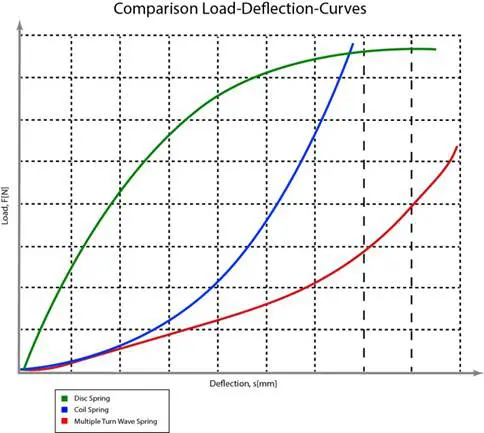
Wave springs load more linearly. The force-deflection curve for a multi-turn wave spring is linear, between 30% and 70% deflection, in contrast to the progressive behavior of coil and disc springs. Linear behavior lets designers more accurately dial in spring force, for instance to preload a seal without excessive wear.
|
|
 |
Wave springs do not create torsion. Wave springs act in a single axis while all coil springs have a torsional reaction to compression. Coil-spring torsion can rotate preloaded parts and cause premature wear as well as potentially decrease the spring’s working load. |
 |
 |
Wave springs have less wear and fatigue. Other sources of wear in springs include edge wear in disc springs and weld failure under dynamic loading in welded washers. Wave springs, on the other hand, have wide radial surfaces and shimmed ends for wide bearing surfaces, both of which minimize fatigue and wear. |
|