


Key Design Differences Between Wave Springs and Coil Springs
Looking for a spring that saves space without sacrificing force? Discover why flat wire wave springs are the preferred choice for engineers.
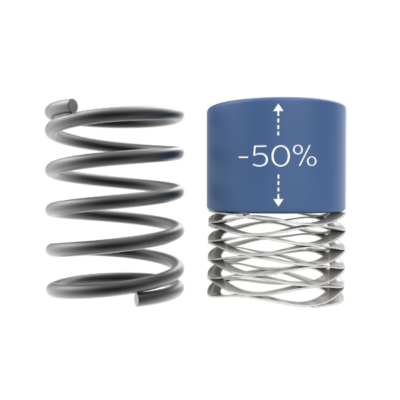
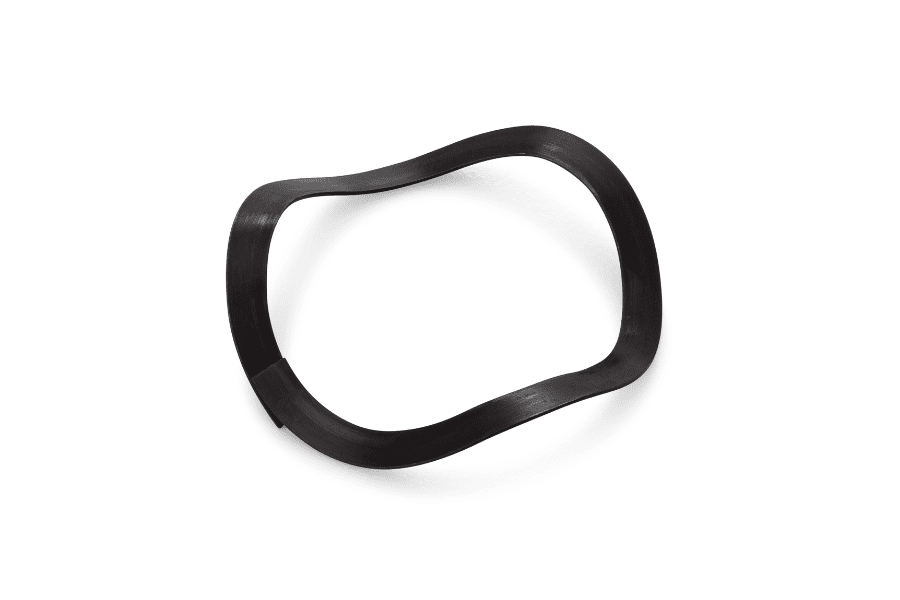
Engineers who rely on traditional coil and disc springs often face limitations related to axial space, weight, and force consistency. A wave spring is a flat wire compression spring characterized by its wave shape. Unlike traditional coil springs, wave springs generate force through bending rather than torsion. This design allows them to compress and expand efficiently while occupying up to 50% less axial space than traditional compression springs. These springs are used in a wide range of applications, including bearing preload, fluid connectors, mechanical seals, and power transmission systems.
Wave springs can simplify assembly. Many designs can locate themselves in a bore or on a shaft, reducing the need for extra retaining features. In applications that use stacked disc springs to meet load or travel requirements, a single multi-turn wave spring can often replace the entire stack. This reduces part count, simplifies handling, and lowers the chance of assembly errors.

Technical Features & Benefits
Axial Space Savings
One of the key benefits of wave springs is their ability to save axial space. In static applications, a wave spring typically requires only 50% of the work height needed by a coil spring while delivering an equivalent force. In dynamic applications, space savings are generally around 30% because additional turns are often required to manage bending stresses without fatigue. These differences are a result of multi-turn wave spring design and how the number of turns affects work height.
Consistent Spring Force
Spring elements typically exhibit both linear and non-linear force behaviors depending on their deflection. Wave springs provide a broader and flatter linear force region across their deflection range. This allows engineers to achieve more predictable spring forces, which is critical in applications like mechanical seals, where accurate preload balances wear and leakage. Single-turn wave springs typically maintain linear force between 30% and 70% of deflection, while multi-turn designs cover a slightly wider range. Coil and disc springs have narrower linear regions, making it more difficult to maintain consistent force.
Increased Travel
When compared to a traditional disc spring, multi-turn wave springs can offer far more travel. One multi-turn wave spring can replace multiple disc springs used to achieve a specific travel range. While most applications require short travel distances, typically less than 1 mm, wave spring designs can be engineered for much larger travel distances when needed Replacing a stack of disc springs with a single wave spring also reduces the chance of installing the wrong number of components and simplifies assembly.
Dial-in Spring Rate
Wave spring stiffness is defined by material thickness, spring material, the number of waves per turn, and the number of turns. Engineers can tune these variables to obtain the required spring rate for a particular application without changing the spring’s overall envelope. Optimizing the number of waves per turn is a practical method to adjust stiffness while maintaining desired load characteristics.
Dimensional Tolerance Improvements
Wave springs maintain consistent force over a broader range of deflections, which allows greater flexibility in the dimensional tolerances of spring cavities and mating shafts. When force is predictable across deflection, designers can avoid overly tight tolerances that would otherwise be necessary to meet specific force requirements. This flexibility can reduce manufacturing costs while maintaining performance integrity.

In the chart above, you can see how a single-turn wave spring, a coil spring, and a multi-turn wave spring behave under load and deflection. Increasing the number of waves per turn changes the spring’s free height and compressed diameter, adding some hysteresis because each wave produces a small amount of friction during compression. These effects can be addressed during design. Free height and diameter can be calculated to meet application requirements, and hysteresis can be minimized by presetting the wave spring, which involves compressing it to its work height over several cycles.
Highly Customizable
Unlike stamped parts, which require dedicated tooling, wave springs can be adapted quickly without additional cost or delays. Rotor Clip wave springs are fully customizable and produced to exacting standards to ensure reliable performance. In-house processes allow engineers to adjust material thickness, number of waves, number of turns, alloy selection, end configurations, and other parameters to meet specific application requirements. Vertical integration provides precise control over rolling and coiling, maintaining consistent material properties, and dimensional accuracy. Specifying high-quality, properly manufactured wave springs ensures predictable force, consistent deflection, and reliable performance while providing the flexibility engineers need for both standard and specialized designs.
Our engineers will work with you to evaluate your requirements and identify the right spring solution for your application. Contact us to discuss your design.
Mehr als nur Teile. Eine echte Partnerschaft.
Unsere Leidenschaft gilt der Herstellung der besten Ringe, Federn und Klemmen. Unsere Mission besteht darin, Ihre Arbeit zum Erfolg zu führen. Wir sind für Sie da.