



Spiral Rings vs Circlips: Which Retaining Ring is Right For Your Application?

When selecting a retaining ring for your application, size alone does not determine performance. Ring geometry, installation method, and load distribution within the groove all influence how a ring behaves in your assembly. For example, spiral retaining rings and tapered section rings (circlips) both secure components within a groove, but they achieve retention in fundamentally different ways. Spiral rings rely on a continuous coiled geometry that engages the groove uniformly around the circumference. Circlips use a stamped, lug-based design that compresses into position and locks into place through defined contact points.
In this guide, we’ll walk you through the key differences between each ring design and which one may be the better fit for your requirements.
What is a Spiral Retaining Ring?
Spiral retaining rings are formed from a continuous length of flat wire that is coiled into a multi-turn or single-turn spiral profile. This creates a continuous ring geometry without lugs or defined end points. Unlike stamped retaining ring designs, spiral rings engage the groove through continuous contact around the circumference, creating a uniform interface between the ring and the housing or shaft. This geometry supports even load distribution around the groove once installed and helps minimize localized stress concentrations.
The lug-free profile of a spiral ring eliminates protrusions that may interfere with surrounding components, making them well suited for assemblies with limited clearance requirements. In multi-turn configurations, spiral rings provide 360° groove contact for consistent engagement around the assembly. They are available in internal and external designs and can be manufactured in materials including stainless steels, Inconel, and Elgiloy to meet application requirements.
Rotor Clip spiral rings also offer customization flexibility in diameter and number of turns. The coiling process allows for efficient production with minimal material scrap, providing a cost-effective solution for a wide range of applications.
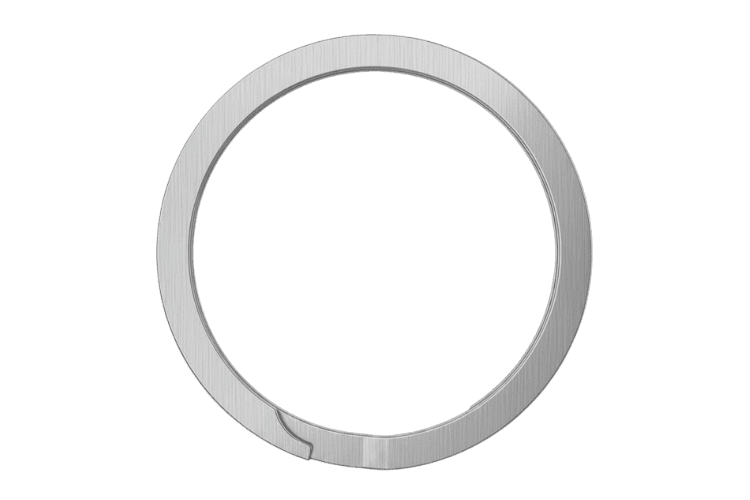
Spiral Ring Installation
Spiral retaining rings are installed by guiding the leading end into the groove and progressively winding the ring into place until fully seated. Unlike circlips, spiral rings do not require pliers or dedicated installation tooling, although simple tooling can be used for high-speed automated assembly. Once installed, the ring maintains continuous contact around the groove circumference. For removal, the ring’s removal notch or scallop allows a screwdriver to be used to wind the ring out of the groove.
Common Applications for Spiral Rings
Spiral retaining rings are commonly used in assemblies such as rotary unions, quick connect fittings, valves, couplings, and precision equipment in space-constrained or high-performance environments.
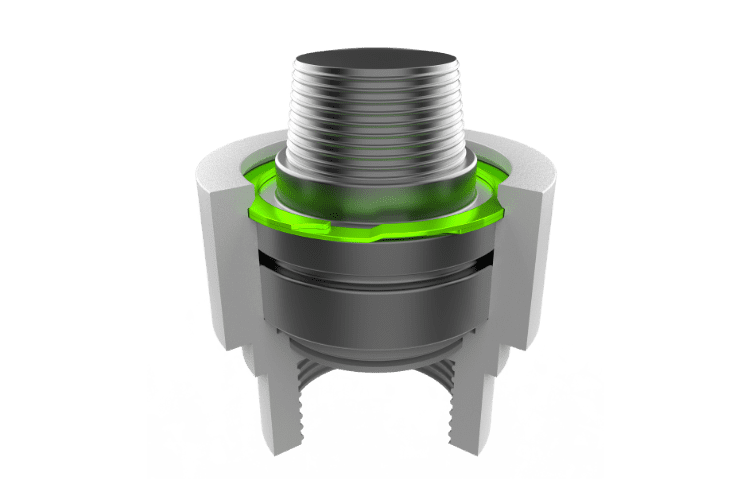
Typical application characteristics include:
- Tight radial or axial clearance requirements
- Assemblies where lug interference cannot be tolerated
- Need for uniform load distribution around the groove
- Designs requiring a smooth, continuous ring profile within the assembly
What is a Circlip?
Tapered section retaining rings, commonly referred to as circlips, are widely used retaining ring designs valued for their strength and versatility. The ring features a tapered cross-section, where the radial wall height gradually decreases from the top of the ring toward the free ends and lugs. This geometry promotes even stress distribution and supports strong axial load capability. As a result, the ring maintains secure engagement within the groove and can withstand significant thrust loads across a wide range of assemblies.
Unlike spiral retaining rings, circlips use an open ring design with integrated lugs and lug holes, allowing them to be installed and removed using standard retaining ring pliers, applicators, or automated assembly equipment. Their near full circular contact within the groove provides consistent engagement for applications requiring dependable axial retention.
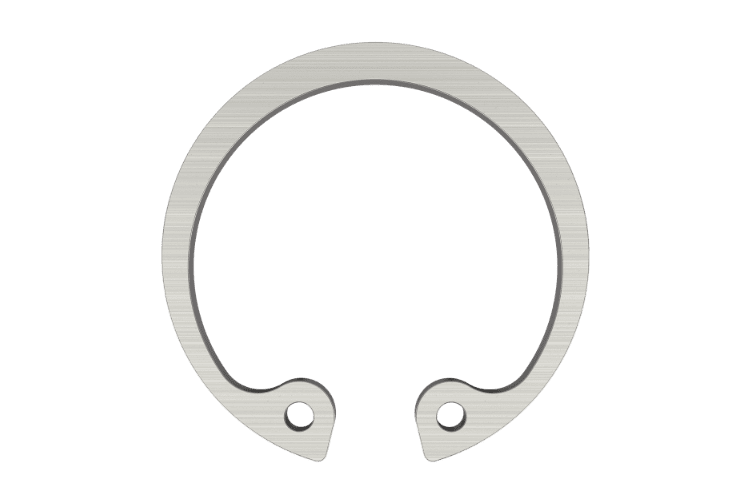
Circlip Installation
Circlips are installed using retaining ring pliers or automated assembly equipment that compress the ring’s lugs, allowing it to enter the groove. Once released, the ring expands and seats securely within the groove. This installation method supports repeatable, tool-based assembly in high-volume production environments. For removal, the same compression process is used to disengage the ring for service or replacement.
Common Applications for Circlips
Tapered section retaining rings, or circlips, are commonly used in assemblies such as gearboxes, bearings, transmissions, and hydraulic systems where controlled axial retention and efficient assembly are required.
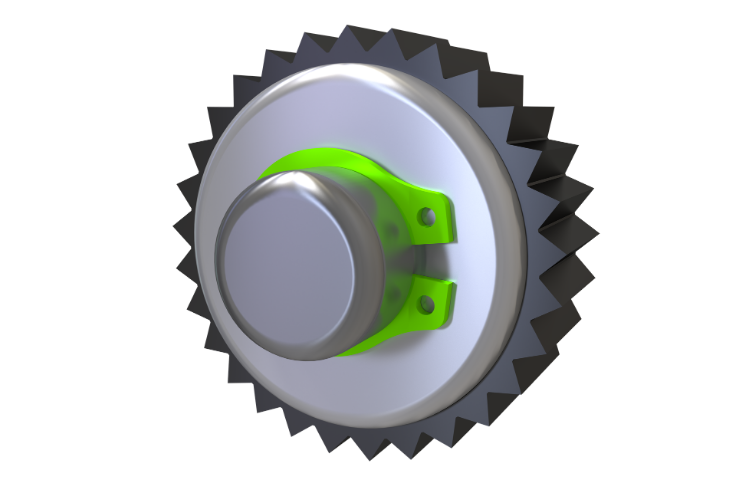
Typical application characteristics include:
- High thrust load retention requirements
- Standardized assemblies designed for pliers or automated installation
- High-volume production environments
- Fast, repeatable installation cycles
A Side-by-Side Comparison
Selecting between a spiral retaining ring and a tapered section ring (circlip) is typically driven by how the assembly manages space, load, and installation. Each design uses a different retention approach, which directly affects groove engagement, tooling requirements, and assembly behavior.
The table below summarizes the key differences in how each ring is manufactured and performs in an application.
| Feature | Spiral Retaining Ring | Tapered Section Ring (Circlip) |
|---|---|---|
| Manufacturing Method | Coiled flat wire | Stamped from strip material |
| Ring Geometry | Continuous spiral profile | Open ring with lugs |
| Groove Engagement | Full 360° contact (multi-turn) | Near full circular contact |
| Load Distribution | Even load distribution around groove | Localized load points at engagement areas |
| Installation Method | Wound into groove | Installed with pliers or automated tooling |
| Clearance Requirements | No lug interference | Requires clearance for lugs |
| Assembly Behavior | Gradual, continuous engagement | Snap-in compression and release |
Spiral Retaining Ring vs. Circlip: FAQs
Explore some of the most common questions engineers ask when selecting between a spiral ring and a circlip.
Spiral retaining rings are typically selected for applications with tight clearance requirements or where lug interference cannot be accommodated, such as rotary equipment, couplings, valves, and precision assemblies that require uniform groove engagement. Circlips are commonly used in applications requiring higher thrust load capability and efficient, tool-based installation, including gearboxes, bearings, transmissions, and hydraulic systems.
Selection is influenced by groove design, load requirements, available space, installation method, and material compatibility. These factors determine which retaining ring style is best suited for the application.
Using a retaining ring that is not suited to the application can result in improper groove engagement, installation challenges, or reduced retention performance under operating conditions. In some cases, this may lead to loss of secure fit within the assembly depending on load, geometry, and installation constraints.
Installation method can influence assembly speed, tooling requirements, and production scalability. Circlips are typically installed using pliers or automated equipment, while spiral rings are installed by winding into the groove without dedicated lugs or installation tools.
Both spiral retaining rings and circlips can be customized for load and rotational capacity, tolerance, section and thickness, and materials. Spiral rings offer additional customization options including coiling direction and locking and balance features, whereas circlips offer additional options in profile modifications and finishes.
Engineering Support for Retaining Ring Selection
A standard retaining ring won’t always meet the requirements of an application. Load conditions, geometry, installation method, and material selection can all determine whether a standard part is suitable for the assembly. In those cases, Rotor Clip engineers work with customers to develop custom retaining ring solutions that meet specific application requirements.