


Step 1: Identify the Application
Determine whether the retaining ring will be installed on a shaft, inside a housing or bore, or radially onto a shaft. This determines the appropriate DIN retaining ring configuration for the application.
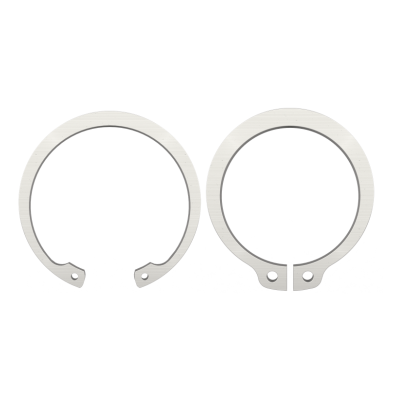
If you’ve ever searched for a metric circlip or snap ring, you’ve probably encountered DIN numbers like DIN 471, DIN 472, or DIN 6799. But what do those standards actually mean, and why are they important? While many of these rings look similar, each standard defines its own dimensions and groove requirements. Understanding these differences is key to selecting the correct retaining ring and avoiding fit, installation, and performance issues.
As the only manufacturer of every style of retaining ring, Rotor Clip offers one of the industry’s most comprehensive ranges of inch and metric retaining rings, including standard and custom designs. In this blog, we’ll explain what DIN standards are and how to identify the appropriate Rotor Clip series for your application.
DIN stands for Deutsches Institut für Normung (German Institute for Standardization), Germany’s national standards organization. Founded in 1917, DIN was established to develop standardized technical specifications that improve quality, safety, and interchangeability across industries. Over the past century, DIN standards have become widely recognized throughout Europe and are now used globally for thousands of engineering products and components.
Rotor Clip manufactures a comprehensive range of DIN circlips (tapered section retaining rings) and snap rings (constant section retaining rings) at both our U.S. and European manufacturing operations. Backed by extensive in-house manufacturing capabilities, Rotor Clip DIN retaining rings support automotive, aerospace, industrial, and agricultural applications while providing consistent quality, reliable global supply, and expert application support.
The table below identifies the corresponding Rotor Clip series for each DIN retaining ring standard.
| Rotor Clip Series | Description |
|---|---|
| DSH / DSR | DIN 471: External circlip installed in a groove on a shaft with a protruding shoulder to prevent axial movement. Reinforced version (DSR). |
| DHO / DHR | DIN 472: Internal circlip installed in a groove in a housing or bore with a protruding shoulder to prevent axial movement. Reinforced version (DHR). |
| DST | DIN 983: External circlip with teeth installed on a shaft. The teeth create an extended shoulder for increased axial retention. |
| DHT | DIN 984: Internal circlip with teeth installed in a housing or bore. The teeth create an extended shoulder for increased axial retention. |
| DE | DIN 6799: External E-ring installed radially into a groove on. Its E-shaped configuration provides three points of contact for secure retention. |
| CBS | DIN 5417: External metric bearing snap ring installed on a shaft for bearing retention. |
| CRS | DIN 9925: External metric snap ring made from round wire and installed in a shaft groove. |
| CRH | DIN 9926: Internal metric snap ring made from round wire and installed in a housing or bore groove. |
| CFS | DIN 9927: External metric snap ring made from flat wire with speared or straight ends depending on shaft diameter. |
| CFH | DIN 9928: Internal metric snap ring made from flat wire with angled or asymmetrical ends depending on housing diameter. |
Selecting the correct DIN retaining ring requires more than identifying the shaft or housing diameter. Engineers should also consider the installation location, assembly method, applicable DIN standard, groove dimensions, load requirements, and operating environment. Rotor Clip engineers can help identify the appropriate DIN standard and corresponding Rotor Clip series, or recommend a custom retaining ring solution when a standard part does not meet application requirements.
Determine whether the retaining ring will be installed on a shaft, inside a housing or bore, or radially onto a shaft. This determines the appropriate DIN retaining ring configuration for the application.
Review the engineering drawing or specification to identify the required DIN standard before selecting the corresponding Rotor Clip series.
Confirm that the groove dimensions and tolerances match the selected DIN standard. Retaining rings with the same nominal shaft or housing diameter may require different groove dimensions depending on the applicable DIN standard.
Evaluate load requirements, operating environment, material and finish requirements, rotational speed, available clearance and assembly process to ensure the selected DIN retaining ring is appropriate for the application.
Explore answers to some of the most frequently asked questions about DIN circlips, snap rings, and retaining ring standards.
Not always. DIN circlips and snap rings are manufactured to specific dimensions, tolerances and groove requirements. Always verify the DIN standard, ring dimensions and groove specifications before replacing one circlip for another.
Contact a Rotor Clip engineer for retaining ring selection assistance
A reinforced DIN circlip has a larger radial wall and cross-section than a standard circlip, allowing it to support higher axial loads. Rotor Clip reinforced DIN circlips are available for applications requiring increased retaining capacity.
DIN circlips and snap rings are manufactured to defined DIN specifications. If a standard DIN retaining ring does not meet your application requirements, Rotor Clip can develop a custom metric retaining ring based on your specific size, material, finish, and performance requirements.
Yes. Depending on the ring style, size, packaging and application, Rotor Clip DIN retaining rings, circlips, and snap rings are suitable for both manual, semi-automated and automated assembly. Installation options may include using standard retaining ring pliers, applicators, dispensers and automated feeding systems, .
In addition to DIN, Rotor Clip manufactures ANSI Metric circlips and JIS radial retaining rings for applications requiring other internationally recognized metric standards.
Unsere Leidenschaft gilt der Herstellung der besten Ringe, Federn und Klemmen. Unsere Mission besteht darin, Ihre Arbeit zum Erfolg zu führen. Wir sind für Sie da.