


Application Spotlight: Single-Turn Wave Spring in a Centrifugal Water Pump
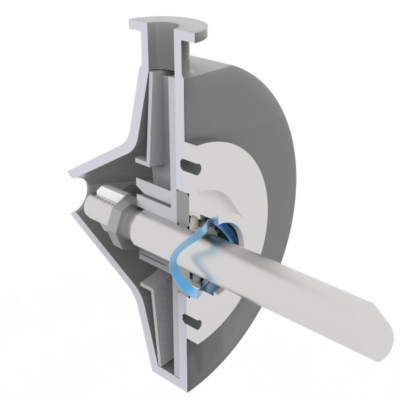
Centrifugal water pumps place demanding requirements on the components that support the rotating shaft. The bearings must handle axial loads while staying correctly positioned, often within a compact space.
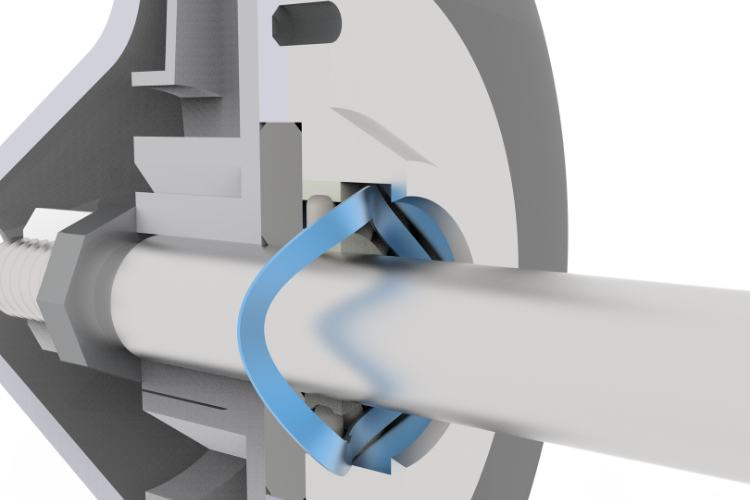
In this Application Spotlight, we look at how a single-turn wave spring is used in a centrifugal water pump for a large diesel engine, such as those used in locomotives. Installed around the shaft within the pump housing, the wave spring engages the housing and the drive-end outer bearing race to apply axial preload to the bearing assembly.
The Application
Centrifugal Water Pump
In this centrifugal water pump design, a motor drives a rotating shaft with an impeller mounted at the end. As the impeller rotates, it draws water into the pump and directs it outward through its blades, circulating water through the diesel engine’s cooling system. The shaft is supported by tapered roller bearings that experience significant axial thrust loads during operation.
Without consistent axial control, the bearings can shift and vibrate under changing thrust loads, leading to premature wear and potential pump damage.
The Solution
Applying Bearing Preload with a Single-Turn Wave Spring
A single-turn wave spring applies axial preload to the bearing assembly. Installed around the shaft within the pump housing, the spring engages the housing and the drive-end outer bearing race. When compressed to its work height, the wave spring applies the spring force needed to help maintain bearing position while accommodating dimensional variation within the assembly.
During operation, the wave spring’s preload counters the reverse thrust acting on the tapered roller bearings, limiting unwanted bearing movement and vibration. This supports longer bearing and pump life while reducing maintenance.
Why a Single-Turn Wave Spring Fits the Application
Single-turn wave springs deliver controlled axial force over a short deflection range, and their low profile fits easily into the narrow space between the housing and bearing race.
A single-turn design can be a good fit when the application requires:
- A controlled axial preload
- Short spring deflection
- Limited axial and radial installation space
- Compensation for dimensional variation
Applications that need greater deflection or travel may be better suited to a multi-turn wave spring.

Design Considerations for Similar Applications
As a wave spring compresses from its free height to its working height, it develops the axial force needed to preload the bearings. Manufacturing tolerances can affect the installed height and consequently, the force applied to the bearing arrangement. Engineers must account for this variation to ensure the spring provides sufficient preload without introducing excessive bearing loads or friction.

When selecting a single-turn wave spring for similar applications, key design considerations include:
- Required Load: The axial force the spring must provide at its installed position.
- Free Height: The height of the spring before a load is applied.
- Work Height: The installed height of the spring once the assembly is complete.
- Deflection: The difference between the spring’s free height and its compressed height.
- Dimensional Tolerances: Variations in mating components that may affect spring compression and the resulting load.
- Installation Space: The available axial and radial space for the spring.
- Operating Conditions: Temperature, corrosion exposure, and other environmental factors that may influence material or finish selection.
Evaluate these factors together. A spring that fits dimensionally must still deliver the required load across the assembly’s full working- range.
Need Support with a Wave Spring Application?
Choosing the right wave spring depends on more than diameter alone. Rotor Clip engineers can review your load, space, material, and operating requirements and recommend whether a standard or custom wave spring is the right fit for your assembly.
Frequently Asked Questions About Single-Turn Wave Springs
A single-turn wave spring provides axial spring force over a relatively short deflection range. It can be used for applications such as bearing preload, tolerance compensation, maintaining contact between assembly elements, and other designs where controlled spring force is required within limited axial space.
A single-turn wave spring can apply a controlled axial force to a bearing while fitting within a compact installation space. When compressed to its designed working height, the spring applies preload that can help maintain the intended axial condition within the bearing arrangement. The right preload depends on the bearing and assembly design.
Both can provide axial spring force, but they are manufactured differently and can provide different load and spring-rate characteristics. Single-turn wave springs are formed and coiled from continuous flat wire and can be designed around specific load, working-height, diameter, and application requirements. Stamped wave washers are produced from sheet material that is subject to varying tolerances than cannot be adjusted during the manufacturing process. Rotor Clip single-turn wave springs are available with controlled load and spring-rate tolerances for applications requiring repeatable spring performance.
Free Height (FH) is the height of the wave spring before a load is applied. Work Height (WH) is the height of the spring when installed and operating in the assembly. The difference between these heights represents the spring’s deflection, which determines the load. Because assembly tolerances change the work heigh, engineers should design around the full expected range.
Single-Turn wave springs are available in a range of materials selected according to load requirements, temperature, corrosion exposure, and the operating environment. Common options include carbon spring steel and stainless steels, while specialty alloys such as Inconel and Elgiloy are available for more demanding conditions. For pump applications, material selection depends on where the wave spring is located and what it is exposed to. A spring located within a bearing housing may have different material requirements than one exposed directly to the pumped fluid.
Yes. Single-turn wave springs can be designed around application-specific requirements including diameter, load, work height, material, finish, and installation geometry. Options include end configurations such as overlap, gap-type, and patented flat-ends, and cling-in bore or cling-on shaft styles. Custom wave springs can be useful when a standard spring does not provide the required combination of load, deflection, dimensions, or environmental performance.
Single-turn wave springs are used in assemblies that require a controlled axial spring force over a relatively short deflection range. Common applications include bearing preload, valve assemblies, quick-connect systems, seals, and other designs requiring tolerance compensation or limited axial installation space.
Mehr als nur Teile. Eine echte Partnerschaft.
Unsere Leidenschaft gilt der Herstellung der besten Ringe, Federn und Klemmen. Unsere Mission besteht darin, Ihre Arbeit zum Erfolg zu führen. Wir sind für Sie da.