


Required Load
Determined the spring load needed to maintain preload and reduce vibration and operating noise.
Explore Available Wave Spring Styles Request Wave Spring Samples
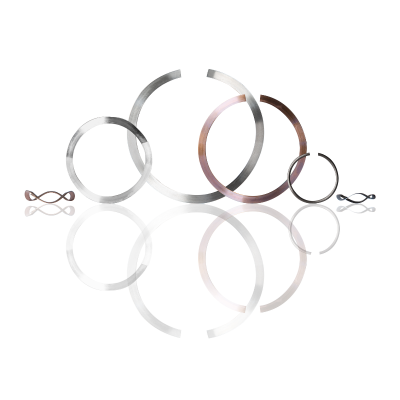
In electric motor assemblies, controlling endplay, vibration, and noise is important for maintaining reliable performance. While retaining rings are designed to securely retain components within an assembly, some applications require additional spring force to compensate for tolerances and maintain preload between components.
This case study highlights how Rotor Clip engineers worked with an automotive manufacturer to evaluate their application, identify the source of vibration and noise, and develop a custom Single-Turn Wave Spring solution that improved system performance while supporting the customer’s development timeline.
A leading international automotive supplier approached Rotor Clip during the development of a high-voltage electric motor for a next-generation drive system. The application required reliable axial retention while minimizing vibration and operating noise throughout the motor assembly.
During the initial design phase, the customer selected a beveled retaining ring to control endplay within the assembly. During prototype testing, however, vibration and excessive noise remained present, affecting overall system performance. After evaluating the application, Rotor Clip engineers recommended replacing the retaining ring with a custom single-turn wave spring. The wave spring provided the required preload to control axial clearance, reduce vibration and improve assembly stability.
A Single-Turn Wave Spring is coiled from a single strip of flat wire and is designed for applications requiring low to medium thrust loads, with performance characteristics that vary based on the spring design and wire type. Available for a wide range of bore and shaft diameters, Single-Turn Wave Springs provide accurate spring rates and loads with tighter tolerances than stamped wave washers or disc springs.
Unlike stamped parts, Single-Turn Wave Springs are manufactured through a coiling process that minimizes material waste. Depending on the application, they can also incorporate cling-in-bore or cling-on-shaft to help position and center the spring during installation. Their compact design makes them well suited for applications requiring accurate, repeatable spring loads, to provide preload or compensate for accumulated tolerances in assemblies.
While the beveled retaining ring provided rigid endplay take-up, the application required continuous axial preload to compensate for tolerances throughout operation. Within the motor assembly, even small amounts of axial clearance could allow unwanted movement between mating components, contributing to vibration, operating noise, and inconsistent performance.
Rotor Clip engineers determined that a custom Single-Turn Wave Spring was better suited to these application requirements. By applying a controlled, continuous spring force, the single-turn wave spring helped maintain consistent contact between mating components and control axial clearance throughout the operating range. This continuous preload helped minimize vibration and operating noise while compensating for accumulated tolerances within the available installation space.
For this high-voltage motor application, meeting the customer’s performance objectives required more than selecting a standard spring configuration. Rotor Clip engineers applied their engineering expertise to develop a custom Single-Turn Wave Spring engineered around the application’s design requirements and installation constraints. To optimize the solution, Rotor Clip engineers refined several key spring characteristics, including:
Determined the spring load needed to maintain preload and reduce vibration and operating noise.
Designed the spring to fit within the available installation space in the existing motor assembly.
Engineered the spring to provide the required load at the application’s specified working height.
Optimized the spring’s deflection range to provide consistent spring performance under the required operating conditions.

Throughout the development process, Rotor Clip engineers worked closely with the customer’s engineering team to evaluate the application, review prototype performance, and refine the custom Single-Turn Wave Spring design. This collaborative engineering approach ensured the final solution was developed around the application’s specific requirements rather than requiring the customer to adapt the assembly around a standard part.
The custom Single-Turn Wave Spring successfully addressed the application challenge while helping the customer move efficiently from prototype testing toward production.
•
•
•
Discuss your application with Rotor Clip engineers to develop a wave spring solution optimized for your performance requirements.
Explore common questions about Single-Turn Wave Springs and custom wave spring solutions.
A Single-Turn Wave Spring is a coiled flat-wire compression spring designed to provide accurate, repeatable spring loads within a compact axial space. It is commonly used to provide preload, compensate for tolerances, and reduce vibration or endplay in mechanical assemblies. Compared to stamped wave washers or disc springs, Single-Turn Wave Springs provide tighter load and spring-rate tolerances.
Single-Turn Wave Springs can be customized to meet specific application requirements, including spring load, working height, deflection, dimensions, materials, and finishes. Rotor Clip engineers work with customers to develop application-specific solutions when a standard spring does not meet the required performance or installation requirements.
Single-Turn Wave Springs apply a continuous spring load that helps maintain preload between mating components. By compensating for tolerances and reducing unwanted axial movement, they can minimize vibration, operating noise, and endplay while improving overall assembly stability.
Single-Turn Wave Springs are available in a variety of materials to meet specific application and environmental requirements. Standard materials include carbon spring steel and stainless steel, while specialty alloys are available for applications requiring enhanced corrosion resistance, elevated temperature capability, or specialized performance characteristics. Available finishes depend on the selected material and application requirements
Unsere Leidenschaft gilt der Herstellung der besten Ringe, Federn und Klemmen. Unsere Mission besteht darin, Ihre Arbeit zum Erfolg zu führen. Wir sind für Sie da.